
Introduction
Every time a user enters sensitive information into a website — a password, a credit card number, or personal details — that information travels across the internet through a complex network of routers, switches, and servers before reaching its destination. Without proper protection, this data could be intercepted, read, or altered by anyone with access to the network path in between. SSL/TLS encryption, delivered to users through HTTPS, is the foundational technology that makes secure communication on the web possible. This final article in our website security series explores what SSL/TLS and HTTPS are, how they work, why they matter, and how organizations can implement them correctly.
What Are SSL and TLS?
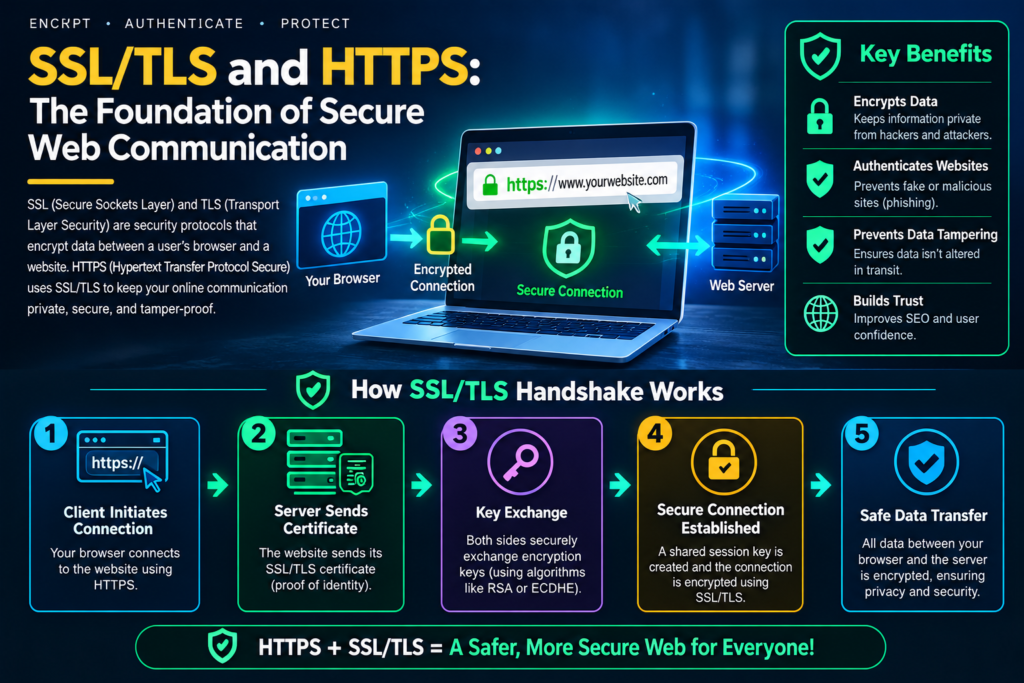
SSL (Secure Sockets Layer) and TLS (Transport Layer Security) are cryptographic protocols designed to provide secure communication over a computer network. TLS is the modern successor to SSL; the original SSL protocol has been deprecated for years due to known security vulnerabilities, and virtually all secure web communication today actually uses TLS, even though the term “SSL” is still used colloquially and in marketing materials as a general term for this category of technology.
These protocols operate between the application layer (where web browsers and servers exchange data) and the transport layer (which handles the actual delivery of data packets across the network). Their primary purpose is to ensure three critical security properties for data transmitted over a network:
Confidentiality: Data is encrypted so that even if it is intercepted during transmission, it cannot be read by unauthorized parties.
Integrity: Data cannot be altered or tampered with during transmission without detection.
Authentication: The identity of the server (and optionally the client) can be verified, ensuring users are actually communicating with the legitimate website they intend to reach, rather than an imposter.
What Is HTTPS?
HTTPS (Hypertext Transfer Protocol Secure) is simply the standard HTTP protocol used for web communication, layered on top of SSL/TLS encryption. When a user visits a website using HTTPS instead of plain HTTP, all data exchanged between their browser and the website’s server is encrypted using TLS, protecting it from interception and tampering. Most modern browsers visually indicate whether a connection is secure, typically displaying a padlock icon in the address bar for HTTPS sites, while flagging non-HTTPS sites as “Not Secure.”
How SSL/TLS Works: The Handshake Process
Establishing a secure TLS connection involves a process known as the “TLS handshake,” which occurs before any actual application data is exchanged. While the technical details can be complex, the process can be understood at a high level through the following stages:
1. Client Hello: The user’s browser initiates the connection by sending a message to the server indicating which TLS versions and encryption methods (cipher suites) it supports.
2. Server Hello: The server responds, selecting a TLS version and cipher suite from those offered, and sends its digital certificate, which contains the server’s public key and identity information.
3. Certificate Verification: The browser verifies the server’s certificate against a list of trusted Certificate Authorities (CAs) to confirm the server’s identity is legitimate and has not been tampered with.
4. Key Exchange: The browser and server use cryptographic techniques to securely establish a shared secret key, which will be used to encrypt all subsequent communication, without that key ever being transmitted in a way that could be intercepted and read by a third party.
5. Secure Communication Begins: Once the handshake is complete, both the browser and server use the agreed-upon shared key to encrypt and decrypt all data exchanged during the session, using efficient symmetric encryption algorithms.
This entire process typically happens in a fraction of a second, invisible to the end user, who simply sees the website load with a secure connection indicator.
Digital Certificates and Certificate Authorities
A critical component of the SSL/TLS system is the digital certificate, which serves as a form of digital identification for a website. Certificates are issued by trusted third-party organizations known as Certificate Authorities (CAs), which verify the identity of the certificate applicant before issuing a certificate. This creates a “chain of trust” that allows browsers to verify that a website is who it claims to be.
There are generally three levels of validation for SSL/TLS certificates:
Domain Validation (DV): The most basic level, where the CA only verifies that the applicant has control over the domain name. This is the fastest and most common type of certificate for general websites.
Organization Validation (OV): The CA performs additional verification of the organization’s legal identity and existence, providing a higher level of assurance, often used by businesses.
Extended Validation (EV): The most rigorous validation process, involving thorough verification of the organization’s legal, physical, and operational existence, historically used by financial institutions and large enterprises, though modern browsers have reduced the visual distinction they give to EV certificates.
Why SSL/TLS and HTTPS Matter
1. Protecting Sensitive Data in Transit
The most fundamental purpose of SSL/TLS is to protect data as it travels across the internet. Without encryption, any sensitive information — login credentials, payment details, personal messages — transmitted between a user and a website could potentially be intercepted by anyone with access to the network path, a technique known as a “man-in-the-middle” attack. This is particularly concerning on unsecured public Wi-Fi networks, where attackers can more easily position themselves to intercept unencrypted traffic.
2. Verifying Website Authenticity
SSL/TLS certificates help protect users from phishing attacks and impersonation by verifying that they are actually communicating with the legitimate website they intend to visit, rather than a fraudulent copy designed to steal their information. While having HTTPS alone does not guarantee a website is trustworthy or legitimate in every sense, it does confirm the technical identity verification performed by the certificate authority.
3. Maintaining Data Integrity
Beyond confidentiality, TLS also ensures that data cannot be modified in transit without detection. This prevents attackers from injecting malicious content, altering transaction details, or modifying any other data as it travels between the browser and server.
4. Search Engine Rankings
Major search engines, including Google, have confirmed that HTTPS is considered a ranking signal in their search algorithms. Websites using HTTPS may receive a modest ranking benefit compared to equivalent non-HTTPS sites, making SSL/TLS implementation beneficial not just for security but also for search engine optimization.
5. Browser Warnings and User Trust
Modern browsers actively warn users when they visit websites without HTTPS, particularly when those sites contain forms for entering sensitive information such as passwords or payment details. These warnings can significantly deter users from proceeding, directly impacting conversion rates and user trust for any website lacking proper encryption.
6. Regulatory and Compliance Requirements
Various data protection regulations and industry standards, including PCI DSS for websites handling payment card data, explicitly require the use of strong encryption for data transmission. Failing to implement HTTPS can result in non-compliance with these requirements, leading to potential fines and loss of the ability to process certain types of transactions.
7. Protecting Modern Web Features
Many modern web browser features and APIs — including geolocation services, service workers (which enable offline functionality and push notifications), and various other capabilities — are only available on websites served over HTTPS, as browsers restrict access to these more sensitive features on unencrypted connections.
Implementing SSL/TLS Correctly
Obtain a Valid Certificate
Website owners must obtain an SSL/TLS certificate from a trusted Certificate Authority. Numerous options exist, ranging from free, automated certificate services to paid certificates offering extended validation and additional features. The appropriate choice depends on the specific needs and risk profile of the organization.
Configure Servers Properly
Simply installing a certificate is not sufficient; servers must also be configured correctly to use modern, secure TLS versions and strong cipher suites, while disabling older, vulnerable protocol versions and weak encryption algorithms that could undermine the security the certificate is meant to provide.
Enforce HTTPS Sitewide
Websites should redirect all HTTP traffic to HTTPS automatically, ensuring users cannot accidentally access an unencrypted version of the site. Implementing HTTP Strict Transport Security (HSTS) headers further strengthens this by instructing browsers to only ever connect to the website using HTTPS in the future, even if a user manually types “http://” or clicks an old link.
Renew Certificates Before Expiration
SSL/TLS certificates have a defined validity period and must be renewed before they expire. An expired certificate will cause browsers to display security warnings to visitors, effectively breaking the trust relationship and potentially driving users away. Automating the renewal process wherever possible helps prevent accidental lapses.
Secure All Subdomains and Resources
A comprehensive HTTPS implementation should cover not just the main website but all subdomains and any resources loaded by the site, such as images, scripts, and stylesheets. Loading any resources over an insecure connection on an otherwise secure page (known as “mixed content”) can undermine the security of the entire page and trigger browser warnings.
Regularly Test Configuration
Various online tools are available to test the strength and correctness of an SSL/TLS configuration, checking for outdated protocol support, weak cipher suites, and other configuration issues. Regular testing helps ensure that a website’s encryption remains strong as security standards and best practices continue to evolve over time.
Conclusion
SSL/TLS and HTTPS form the essential encrypted foundation upon which trustworthy, secure web communication is built. Without these technologies, the modern internet — with its reliance on online banking, e-commerce, and the exchange of sensitive personal information — simply could not function safely. As we conclude this five-part series on website security, it is worth emphasizing that SSL/TLS is not a standalone solution but one critical layer within a comprehensive security strategy that also includes protections against SQL injection, cross-site scripting, DDoS attacks, and the broader security principles discussed throughout this series.
Together, these layers form a defense-in-depth approach that protects not just data in transit, but the entire lifecycle of information as it moves through, is processed by, and is stored within a website’s systems. In an increasingly hostile digital landscape, treating website security as a continuous, evolving practice — rather than a one-time implementation — remains the single most important mindset any organization can adopt to protect its users, its data, and its reputation.