
Introduction
While many cyberattacks focus on stealing or manipulating data, Distributed Denial of Service (DDoS) attacks pursue a different goal entirely: making a website or online service completely unavailable to its legitimate users. A successful DDoS attack can bring down an e-commerce store during peak sales hours, disrupt a financial institution’s online banking services, or take a news website offline during a critical event. This article provides a comprehensive overview of what DDoS attacks are, how they work, the different types of DDoS attacks, their real-world impact, and the strategies organizations can use to defend against them.
What Is a DDoS Attack?
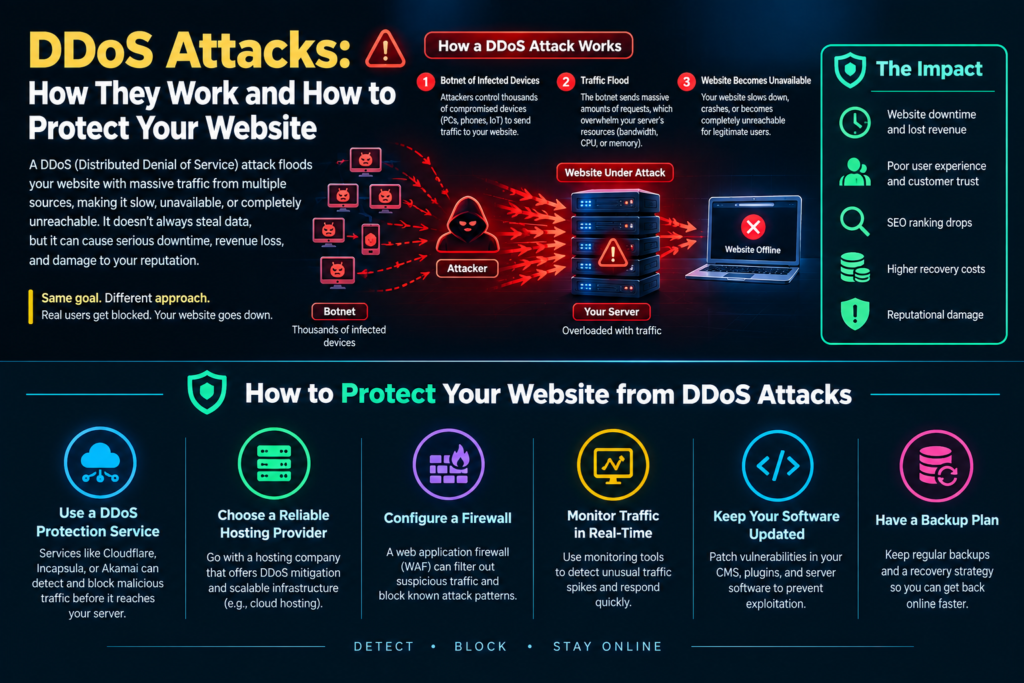
A Denial of Service (DoS) attack is any attempt to make a computer system, network, or service unavailable to its intended users, typically by overwhelming it with excessive traffic or requests. A Distributed Denial of Service (DDoS) attack is a more powerful variant of this same concept, where the attack traffic originates from multiple sources simultaneously, rather than a single machine. This distributed nature makes DDoS attacks significantly more difficult to defend against, since the traffic appears to come from many different locations, making it harder to simply block a single malicious source.
Most DDoS attacks are carried out using a “botnet” — a network of compromised computers, servers, or Internet of Things (IoT) devices that have been infected with malware, allowing an attacker to control them remotely without the knowledge of their owners. When instructed, all of these compromised devices simultaneously send traffic toward a single target, overwhelming its capacity to respond to legitimate requests.
How DDoS Attacks Work
The fundamental principle behind a DDoS attack is resource exhaustion. Every website and online service has finite resources — bandwidth, server processing power, memory, and connection capacity. A DDoS attack aims to consume one or more of these resources entirely, leaving nothing available for legitimate users. When a server becomes overwhelmed, it may respond extremely slowly, drop legitimate requests, or crash entirely, effectively taking the website or service offline.
Types of DDoS Attacks
DDoS attacks are generally categorized into three main types, based on which part of the network stack they target.
1. Volumetric Attacks
Volumetric attacks aim to consume all available bandwidth between the target and the wider internet, essentially flooding the connection with more traffic than it can handle. These attacks are measured in bits per second and are often amplified through techniques that allow attackers to generate a disproportionately large amount of traffic from a relatively small initial request, by exploiting certain internet protocols that respond with much larger replies than the original query. Common examples include UDP floods and DNS amplification attacks.
2. Protocol Attacks
Protocol attacks, also known as state-exhaustion attacks, target weaknesses in the way network protocols handle connections, aiming to exhaust the connection state tables of servers, firewalls, or load balancers rather than overwhelming bandwidth directly. These attacks are measured in packets per second. A classic example is the SYN flood attack, which exploits the standard process used to establish a network connection by sending a flood of initial connection requests without ever completing the handshake process, leaving the server holding open a large number of half-open connections until its resources are exhausted.
3. Application Layer Attacks
Application layer attacks, also known as Layer 7 attacks, target the specific application or website itself, rather than the underlying network infrastructure. These attacks mimic legitimate user behavior, making them particularly difficult to detect and mitigate, since the malicious requests often look identical to genuine traffic from a technical standpoint. A common example is an HTTP flood, where attackers send a massive number of seemingly legitimate HTTP requests — such as repeated page loads or search queries — designed specifically to consume server resources like CPU and memory, particularly targeting resource-intensive operations such as database queries or file generation. Because application layer attacks require relatively less bandwidth than volumetric attacks to achieve significant impact, they have become increasingly popular among attackers.
Real-World Impact of DDoS Attacks
The consequences of a successful DDoS attack extend well beyond simple website downtime:
- Direct revenue loss: For e-commerce and other transaction-based websites, every minute of downtime translates directly into lost sales.
- Reputational damage: Customers who repeatedly encounter an inaccessible website may lose confidence in the organization’s reliability and turn to competitors.
- Operational disruption: Internal business processes that depend on web-based systems, such as customer service platforms or internal tools, can be disrupted alongside customer-facing services.
- Distraction for other attacks: DDoS attacks are sometimes used as a smokescreen to distract security teams while attackers simultaneously attempt other malicious activities, such as data exfiltration, elsewhere in the network.
- Increased infrastructure costs: Organizations using cloud infrastructure that scales automatically based on traffic volume may face unexpectedly high costs from the surge of malicious traffic, even if the attack is eventually mitigated.
- Extortion: Some attackers launch DDoS attacks and then demand payment to stop the attack, a practice known as ransom DDoS (RDoS).
How to Protect Your Website from DDoS Attacks
Effective DDoS protection requires a multi-layered strategy that combines infrastructure planning, specialized mitigation services, and ongoing monitoring.
1. Use a Content Delivery Network (CDN)
A Content Delivery Network distributes a website’s content across a global network of servers, allowing traffic to be served from locations closer to end users. Beyond improving performance, CDNs provide significant DDoS protection benefits by absorbing and distributing large volumes of traffic across their extensive infrastructure, rather than allowing it all to hit a single origin server directly.
2. Deploy DDoS Protection and Mitigation Services
Specialized DDoS protection services are designed specifically to detect and filter out malicious traffic before it ever reaches a website’s servers. These services typically use a combination of traffic analysis, rate limiting, and machine learning-based anomaly detection to distinguish between legitimate users and attack traffic in real time, automatically rerouting or absorbing malicious requests.
3. Implement Web Application Firewalls (WAFs)
A Web Application Firewall can help defend against application-layer DDoS attacks by inspecting incoming HTTP requests and blocking those that match known malicious patterns, exhibit suspicious behavior, or exceed defined rate thresholds, before they ever reach the application server.
4. Configure Rate Limiting
Rate limiting restricts the number of requests a single client (identified by IP address, session, or other criteria) can make within a given time period. This can significantly reduce the effectiveness of application-layer attacks by preventing any single source from overwhelming the server with excessive requests, while still allowing normal user traffic to flow smoothly.
5. Build Scalable, Redundant Infrastructure
Designing infrastructure with scalability and redundancy in mind — using load balancers to distribute traffic across multiple servers, and having the ability to scale resources up quickly during traffic surges — helps absorb the impact of an attack and reduces the likelihood of complete service failure.
6. Develop a DDoS Response Plan
Organizations should have a clearly defined incident response plan specifically for DDoS attacks, outlining roles and responsibilities, communication procedures, escalation paths to DDoS mitigation providers, and steps for restoring service as quickly as possible. Having this plan tested and ready before an attack occurs significantly reduces response time when a real attack happens.
7. Monitor Traffic Continuously
Continuous traffic monitoring allows organizations to detect unusual patterns — such as sudden spikes in traffic, unusual geographic distribution of requests, or abnormal request patterns — early enough to respond before an attack fully escalates. Establishing a baseline of normal traffic patterns makes it much easier to identify anomalies quickly.
8. Secure IoT and Network Devices
Since many DDoS attacks rely on botnets built from compromised IoT devices, organizations and individuals alike should take steps to secure their own network-connected devices — changing default passwords, keeping firmware updated, and disabling unnecessary remote access features — to avoid inadvertently contributing to the botnets used in these attacks against others.
9. Work with Your Internet Service Provider or Hosting Provider
Many internet service providers and hosting companies offer DDoS mitigation services or can assist in filtering malicious traffic upstream, before it even reaches an organization’s own network. Establishing this relationship and understanding available support options in advance can be invaluable during an active attack.
Conclusion
DDoS attacks represent a unique and persistent threat to website availability, distinct from data-focused attacks like SQL injection or XSS, but no less damaging in terms of business impact. As attackers continue to develop increasingly sophisticated techniques — including larger botnets, more effective amplification methods, and application-layer attacks that closely mimic legitimate traffic — organizations must adopt a proactive, multi-layered defense strategy rather than waiting to react after an attack has already begun.
Combining scalable infrastructure, specialized mitigation services, continuous monitoring, and a well-rehearsed incident response plan gives organizations the best chance of maintaining availability even when facing a determined and well-resourced attacker.
In the final article of this series, we will examine SSL/TLS and HTTPS — the foundational encryption technologies that protect data in transit and form an essential part of any comprehensive website security strategy.