
Introduction
SQL Injection (SQLi) remains one of the oldest, most well-known, and yet most persistently dangerous vulnerabilities in web application security. Despite being a documented threat for over two decades, it continues to appear regularly in vulnerability reports and has been responsible for some of the largest data breaches in history. This article provides a comprehensive, end-to-end look at what SQL injection is, how attackers exploit it, the different types of SQL injection attacks, real-world consequences, and — most importantly — how developers and organizations can defend against it.
What Is SQL Injection?
SQL Injection is a code injection technique that exploits a security vulnerability in a website’s database layer. It occurs when user-supplied input is inserted into a SQL query without proper validation or sanitization, allowing an attacker to alter the structure and behavior of that query. Because SQL (Structured Query Language) is the standard language used to communicate with relational databases, an attacker who can manipulate a SQL query can potentially read, modify, or delete any data the application’s database connection has access to.
In simple terms, imagine a login form where a user enters a username and password. If the application builds its database query by directly concatenating user input into a SQL string without any safeguards, an attacker can enter specially crafted text instead of a normal username. That crafted text can trick the database into ignoring the password check entirely, returning data it was never meant to expose, or even executing destructive commands.
How SQL Injection Works
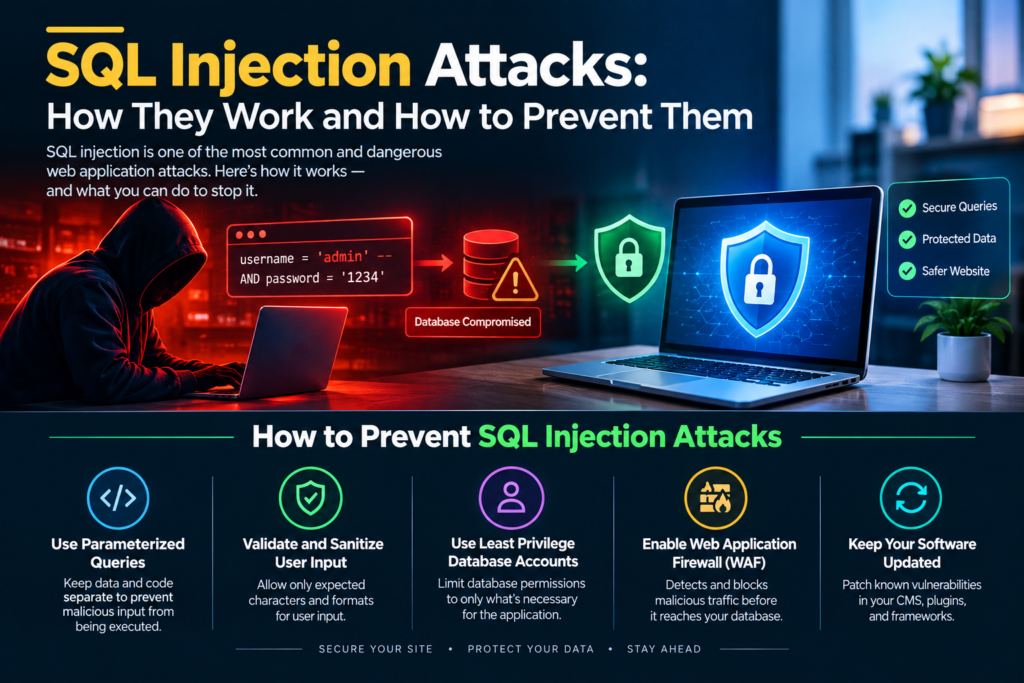
Consider a typical (insecure) query used to check login credentials, built by directly joining user input into the SQL statement. If a website constructs its queries this way, an attacker can enter input crafted to always evaluate as true, regardless of the actual password, or to append additional commands that the database will execute as if they were part of the original query.
This works because the database cannot distinguish between the developer’s intended code and the attacker’s injected code — both arrive as part of the same string. The database simply executes whatever valid SQL syntax it receives.
Types of SQL Injection Attacks
1. In-Band SQL Injection (Classic SQLi)
This is the most straightforward and common type, where the attacker uses the same communication channel to both launch the attack and gather results. It is further divided into two subtypes:
- Error-Based SQLi: The attacker deliberately triggers database errors to gather information about the database structure. Detailed error messages returned by poorly configured applications can reveal table names, column names, and database versions, which the attacker then uses to refine further attacks.
- Union-Based SQLi: The attacker uses the SQL
UNIONoperator to combine the results of the original query with results from a malicious query, effectively extracting data from other tables within the database.
2. Blind SQL Injection
In blind SQL injection, the application does not display database errors or query results directly to the attacker. Instead, the attacker infers information based on the application’s behavior:
- Boolean-Based Blind SQLi: The attacker sends queries that force the application to return different results (such as a different page or response) depending on whether a condition is true or false, gradually piecing together data one bit at a time.
- Time-Based Blind SQLi: The attacker sends queries that cause the database to pause for a specific amount of time if a condition is true. By measuring response times, the attacker can infer information even without any visible difference in the application’s output.
3. Out-of-Band SQL Injection
This less common technique relies on the database server’s ability to make external network requests (such as DNS or HTTP requests) to exfiltrate data to a server controlled by the attacker. It is typically used when in-band and blind techniques are not feasible due to specific server configurations.
Real-World Impact of SQL Injection
SQL injection has been at the heart of numerous high-profile data breaches over the years, affecting organizations across every industry — retail, finance, healthcare, government, and technology. The consequences of a successful SQL injection attack can include:
- Data theft: Attackers can extract entire databases containing customer names, addresses, payment card details, passwords, and other sensitive information.
- Data manipulation: Attackers can modify records, such as changing prices on an e-commerce site or altering account balances.
- Data destruction: Malicious queries can drop entire tables or databases, causing irreversible data loss if backups are not available.
- Authentication bypass: Attackers can log in as any user, including administrators, without knowing valid credentials.
- Full server compromise: In some configurations, SQL injection can be leveraged to execute operating system commands on the underlying server, leading to a complete system takeover.
How to Prevent SQL Injection
The good news is that SQL injection, despite its severity, is highly preventable with well-established secure coding practices. Below are the most effective defense strategies.
1. Use Parameterized Queries (Prepared Statements)
The single most effective defense against SQL injection is the use of parameterized queries, also known as prepared statements. Instead of building SQL queries by concatenating strings with user input, parameterized queries define the SQL command structure first and then pass user input as separate parameters. The database treats these parameters strictly as data, never as executable code, which completely eliminates the ability of an attacker to alter the query’s logic. Virtually every modern programming language and database driver supports parameterized queries, making this a practical solution for nearly all applications.
2. Use Object-Relational Mapping (ORM) Frameworks Carefully
ORM frameworks like Hibernate, Entity Framework, Django ORM, and Sequelize abstract away raw SQL and typically use parameterized queries under the hood, offering a layer of protection by default. However, developers must remain cautious, as many ORMs also allow raw SQL queries or string-based query building for complex operations. Any use of raw queries must still follow secure parameterization practices.
3. Input Validation and Sanitization
While not a substitute for parameterized queries, validating and sanitizing user input adds an important additional layer of defense. This includes enforcing strict data types (ensuring a field expecting a number only accepts numeric input), limiting input length, and using allow-lists (specifying exactly what characters or patterns are permitted) rather than block-lists (trying to filter out known bad characters, which is much easier to bypass).
4. Apply the Principle of Least Privilege to Database Accounts
The database account used by a web application should have only the minimum permissions necessary for that application to function. For example, a public-facing web application rarely needs permission to drop tables or create new database users. Limiting these permissions ensures that even if an injection attack succeeds, the damage an attacker can do is significantly constrained.
5. Implement Web Application Firewalls (WAFs)
A Web Application Firewall sits between users and the web application, inspecting incoming traffic for known attack patterns, including common SQL injection signatures. While a WAF should never be relied upon as the sole line of defense, it provides an important additional layer of protection, particularly against automated scanning tools and known exploit patterns.
6. Avoid Displaying Detailed Error Messages
Detailed database error messages can provide attackers with valuable information about the database structure. Production applications should display generic error messages to users while logging detailed error information securely on the server side for developers to review.
7. Regular Security Testing
Regular code reviews, static application security testing (SAST), dynamic application security testing (DAST), and periodic penetration testing help identify SQL injection vulnerabilities before attackers do. Automated scanning tools can be integrated into the development pipeline to catch these issues early and consistently.
8. Keep Software and Dependencies Updated
Database management systems, web frameworks, and libraries are regularly patched to fix known vulnerabilities, including those related to SQL injection. Keeping all components of the technology stack up to date closes off known attack vectors.
9. Use Stored Procedures Correctly
Stored procedures can help prevent SQL injection when implemented correctly, as they separate the query logic from user input. However, it is important to note that stored procedures can still be vulnerable if they internally construct dynamic SQL by concatenating user input, so this technique must be combined with proper parameterization within the procedure itself.
Testing for SQL Injection Vulnerabilities
Organizations should incorporate SQL injection testing into their regular security assessment routines. This includes automated vulnerability scanning tools that can identify common injection points, manual penetration testing by security professionals who can identify more subtle or complex vulnerabilities, and code review practices that specifically look for unsafe query construction patterns during the development process.
Conclusion
SQL Injection has persisted as a top-tier web application security threat for decades, not because effective defenses do not exist, but because implementing them consistently across every input point in an application requires discipline and awareness. The core lesson is straightforward: never trust user input, and never allow user-supplied data to directly influence the structure of a database query. By adopting parameterized queries as a standard practice, enforcing least-privilege database access, validating input rigorously, and maintaining ongoing security testing, organizations can effectively eliminate SQL injection as a viable attack vector against their websites.
As we continue this security series, the next article will explore Cross-Site Scripting (XSS) — another top web vulnerability that, like SQL injection, stems from improper handling of untrusted input, but targets the browser rather than the database.